

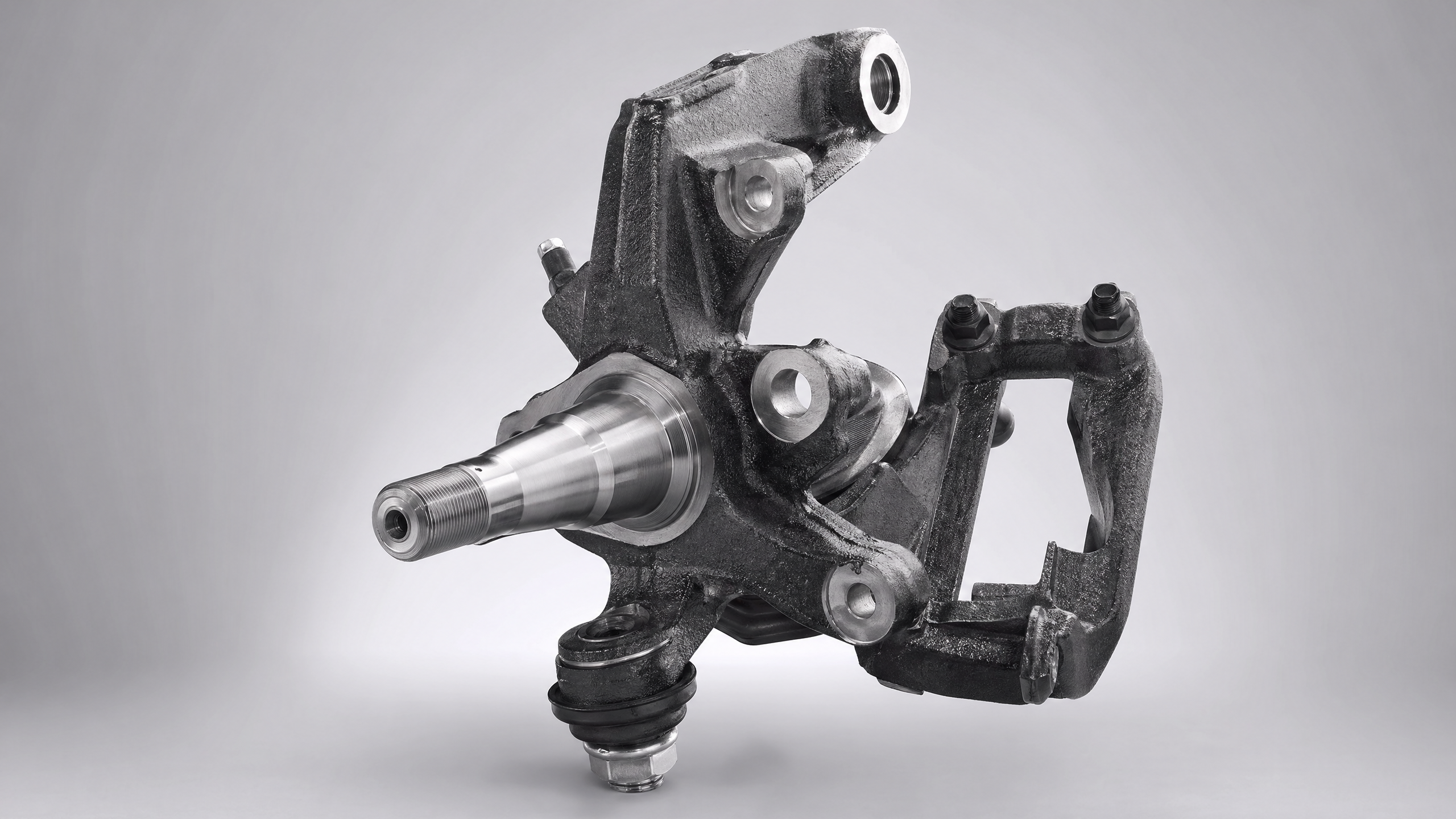
The steering knuckle is the quiet "anchor" of your front end, where the steering, suspension, and brakes all meet. Because it's so interconnected, a bent or worn knuckle is a master of disguise—it often mimics the symptoms of a bad wheel bearing, a worn control arm, or even a faulty steering rack.
Before you start the "parts cannon" and replace components hoping for a fix, here is how to isolate the knuckle as the true root cause.
Warning Signs on the Road
Usually, the knuckle won't tell you it's failing until the symptoms become hard to ignore:
- Uneven Tire Wear: If the inner or outer edges of your tires are balding on a high-mileage Honda Accord or Toyota Camry, your alignment geometry is likely compromised (Camber/Toe misalignment).
- The "Drift": A vehicle that constantly pulls to one side—even after a fresh alignment—often has a knuckle that's slightly out of spec.
- Vibration and Feedback: Shaking felt through the wheel or brake pedal during deceleration is common in heavy-duty trucks like the Ford F-150 when the mounting points begin to fatigue.
- Abnormal Noises: Listen for groaning, humming, or "clicking" during turns or while driving at speed.
Ruling Out the "Power" Systems
The first rule of a precise diagnosis is to exclude the fluid and power layers first. The steering knuckle is a solid mechanical component; it doesn't contain oil.
- Check the Pump: If you hear a whining noise that gets louder as engine RPM rises, that's your power steering pump, not the knuckle.
- Check for Leaks: Puddles of fluid point toward a faulty steering rack or high-pressure hoses.
The Electronic Red Flag
On modern vehicles like the Nissan Altima or Jeep Grand Cherokee, the knuckle serves as the house for the ABS sensor. If your ABS dash light is glowing, inspect the sensor wire and the magnetic tone ring inside the knuckle's bearing. A distorted knuckle or a failed bearing can trigger "Wheel Speed Sensor Signal" error codes.
Physical Verification: The "12 and 6" Test
To get a definitive answer, you need to get the wheels off the ground:
- Grab the tire at the 12 and 6 o'clock positions and wiggle it vertically. Any movement here confirms the wheel bearing or the ball joints—both of which rely on the knuckle's structural integrity—are shot.
- Listen for the "Grind": A low-frequency hum that gets louder as you speed up—and changes pitch when you swerve slightly—is the classic signature of a failing hub bearing within the knuckle.
Visual Proof: The Smoking Gun
Sometimes the evidence is purely visual. Inspect the "arms" of the knuckle for any structural deformity. Even a slight bend from hitting a curb in a Tesla Model 3 or a deep pothole will ruin your suspension geometry. In "salt-belt" states, look for heavy corrosion; if the brake caliper mounting ears have rotted away, the knuckle must be replaced to ensure safe stopping.
Choosing the Right Replacement
Your fix depends entirely on the "Deepest Fault" discovered:
- For Humming & Play: A Complete Knuckle & Hub Assembly is the smartest move for Dodge Ram 1500 owners. It avoids the risk and cost of trying to press a new bearing into a rusted, older knuckle.
- For Bends & Pulling: If the arm is deformed, you need a Structural Steering Knuckle to restore factory suspension geometry.
- For Loose Steering (without noise): You might only need new Tie Rod Ends or Ball Joints if the knuckle itself is straight and the bearing is quiet.
A Note on Drivetrain & Material Variations
When selecting your part, ensure the specs match your specific Year, Make, and Model:
- FWD vs. RWD/AWD: Front-wheel drive knuckles require a hollow center for the CV Axle to pass through.
- Aluminum vs. Iron: If you're working on an Audi, BMW, or high-end truck, you're likely dealing with aluminum. These are weight-saving but sensitive—over-torquing a bolt can crack the entire component.
- ABS Integration: Always verify if your original part uses a "pressed-in" or a "bolt-on" ABS sensor style.
The Bottom Line
A proper diagnosis ensures that when you finally turn a wrench, you're solving the true mechanical root cause. Choosing a pre-assembled unit can simplify the job, providing a "first-time-fit" that gets you back on the road safely without the typical shop headache.